
// Catalogue
Split Case Pumps
5products


Filters
Sort Best selling


Similar products

// Buying guide
How a Split Case Pump Works
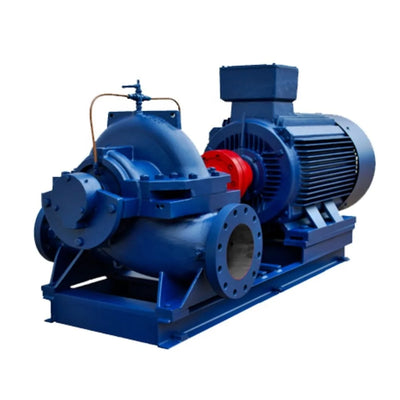
A split case pump is a centrifugal pump with two key differences. First, the casing is split, usually along the horizontal line of the shaft. Second, the impeller draws liquid in from both sides at once, which is why it is called double suction.
Feeding the impeller from both sides brings three big benefits:
- Balanced thrust: the forces along the shaft cancel out, so the bearings last longer.
- Lower NPSH required: liquid enters more gently, which reduces the risk of cavitation.
- High efficiency: large designs are among the most efficient centrifugal pumps made.
A bearing at each end, outside the casing, supports the shaft. This between bearings layout keeps the shaft stiff and the impeller steady, even at very high flows.
Horizontal or Vertical Split Case?
Horizontal Split Case Pumps
This is the classic layout, with the pump and motor side by side on a baseplate. It gives the easiest access for maintenance and suits most water, cooling and fire duties.
Vertical Split Case Pumps
The pump stands upright with the motor on top. This saves floor space in crowded pump stations and plant rooms, while keeping the split casing for service access. Some jobs mean lifting the motor off, so allow crane or hoist access above the pump.
Maintenance Made Simple
On a horizontally split pump, a typical overhaul looks like this:
- Isolate and drain the pump.
- Unbolt and lift off the top half of the casing.
- Lift out the complete rotating assembly: shaft, impeller, bearings and seals.
- Fit a new or refurbished rotating assembly.
- Refit the top casing and restart.
The suction and discharge pipes stay connected to the lower half, and the motor stays in place, so alignment is barely disturbed. Many sites keep a spare rotating assembly on the shelf to cut downtime to a few hours.
Ordering Details That Catch People Out
These pumps are not as interchangeable as smaller ones. Two details matter most:
- Rotation: viewed from the motor end, the shaft turns clockwise or anticlockwise.
- Suction side: viewed from the motor end, the suction branch sits on the left or the right.
Both settings are built into the casing. A pump with the wrong combination will not fit your existing pipework, even if the size and duty match. Always confirm both before ordering.
Split Case Pumps for Fire Services
They are a common choice for fire pump sets because they deliver high flows reliably and are easy to maintain. In Australia, fire pump sets need to meet AS 2941 and must be designed by a qualified fire services engineer. We can supply pumps to suit, and our fire pump skids range covers complete packaged sets. For the wider picture, see our fire protection industry page.
Installation Tips
Double suction pumps are sensitive to uneven flow at the inlet. A few rules help:
- Keep a straight run of suction pipe before the pump, ideally several pipe diameters long.
- If you must fit an elbow close to the inlet, place it in the vertical plane, not the horizontal plane, so flow reaches both sides of the impeller evenly.
- Grout the baseplate on a solid foundation.
- Support the pipework so it does not strain the casing.
- Check the alignment of the coupling after the pipes are connected.
A badly placed suction elbow can starve one side of the impeller, causing noise, vibration and early bearing failure.
Split Case Pumps Specifications to Check
- Flow and head at your duty point, plus the range you need to cover.
- Suction and discharge flange sizes and ratings.
- Rotation and suction side, viewed from the motor end.
- Impeller diameter and material.
- Seal type: mechanical seal or packing.
- Motor power, speed and voltage.
- Fluid type, temperature and solids content.
- Any fire service approvals required.
Signs Your Split Case Pump Needs Attention
Large pumps give plenty of warning if you know what to look for:
- Falling flow or pressure, often from worn wear rings or sleeves.
- Rising bearing temperature at either end of the shaft.
- New vibration, which may point to uneven inlet flow or misalignment.
- Leaks at the seals or packing glands.
- Higher power draw for the same duty.
Trending bearing temperature and vibration each month gives you time to plan an overhaul around production.
Where Split Case Pumps Work
- Town water mains, reservoirs and booster stations.
- Fire services in large buildings, ports and industrial sites.
- Cooling water for power stations and large industrial plants.
- Chilled water in big HVAC systems.
- Irrigation schemes and mine dewatering.
- Desalination and water treatment plants.
Large families such as the Grundfos HS range serve many of these duties.
Split Case or Another Pump?
For smaller flows, end suction pumps cost less and take up less space. If you need high head at modest flow, multistage pumps are usually the better fit. And if space in a building plant room is very tight, vertical inline pumps slot straight into the pipework. Our pump selection and sizing service will help you compare.
What to Send Us
Photograph the nameplate and both ends of the pump. Tell us the rotation and suction side, viewed from the motor end, along with the flange sizes and the liquid being pumped. For fire duties, include the required flow and pressure and any approvals the system needs.
Why Buy From TSA Hydraulics Engineering
As a split case pumps supplier, we check rotation, suction side and flange ratings before we quote, so the new pump drops into your existing pipework. You get OEM or equivalent options, and help sourcing split case pumps replacement parts such as wear rings, shaft sleeves, bearings and mechanical seals. We tell you upfront whether a pump is genuine or an equivalent.