

// Catalogue
70products


Filters
Sort Best selling






Similar products

// Buying guide
How an Air Operated Diaphragm Pump Works
The most common type is the air-operated double diaphragm pump, often called an AODD pump. It has two chambers, each closed off by a diaphragm, and a shaft joins the two diaphragms. Here is the cycle:
- Compressed air pushes the left diaphragm outward, forcing liquid out of the left chamber.
- At the same time, the shaft pulls the right diaphragm inward, drawing liquid into the right chamber.
- An air valve switches the air to the other side.
- The process reverses, and the right chamber now discharges.
- Ball or flap check valves make sure the liquid only travels one way.
There is no electric motor, no rotating seal and no impeller. That simple layout explains most of the pump's strengths.
Why Engineers Choose Diaphragm Pumps
- Runs dry without damage, so an empty drum is not a disaster.
- Self-priming, so it can lift liquid from below the pump.
- Safe against a closed valve. The pump simply stalls, then restarts when the valve opens.
- Handles solids, slurry and thick liquids that would wreck a centrifugal pump.
- No electrics at the pump on air models, which is useful in wet or hazardous areas.
- Easy flow control: adjust the air pressure or volume.
The trade-off is energy. Compressed air is an expensive way to drive a pump, so for duties that run all day, a motor-driven pump may cost less to run.
Body and Diaphragm Materials
With these pumps, getting the materials right matters more than any other choice.
Body Materials
- Polypropylene: a good all rounder for acids and many water based chemicals.
- PVDF: strong acids, solvents and higher temperatures.
- Aluminium: light and tough, for paints, oils and general industrial use.
- Stainless steel: food, pharmaceutical and many solvent duties.
- Cast iron: abrasive slurries and mining duties.
Diaphragm Materials
- TPE (thermoplastic elastomer): long flex life for general and abrasive duties.
- PTFE: resists almost every chemical, and is often backed by a rubber layer.
- Nitrile: oils and fuels.
- EPDM: dilute acids, alkalis and hot water, but not oils.
- FKM: aggressive chemicals and higher temperatures.
Always check the chemical resistance chart for your exact fluid and concentration. A material that handles 10% acid may fail quickly at 98%.
Motor-Driven and Metering Diaphragm Pumps
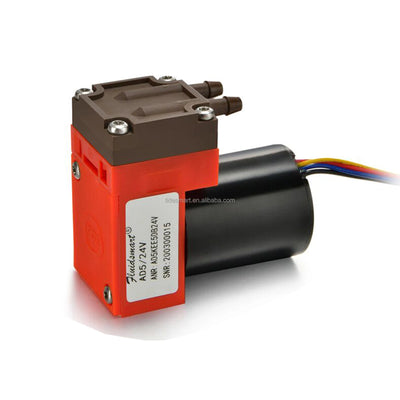
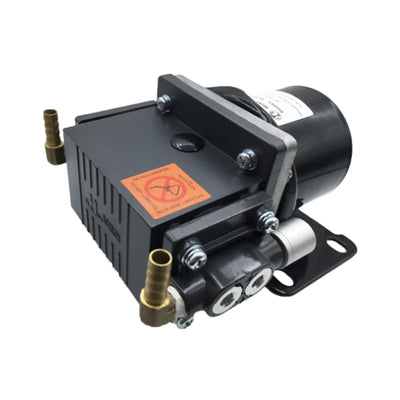
Not every diaphragm pump runs on air. Motor-driven models use an electric motor and a crank or cam to flex the diaphragm. They use far less energy than air models and give a steadier flow.
Metering diaphragm pumps go a step further and deliver a precise volume with each stroke. They dose chlorine, acids, coagulants and other chemicals into water treatment, cooling towers and process lines.
Getting the Air Supply Right
Most problems with air operated pumps start at the air supply:
- Fit a filter regulator close to the pump, so the air stays clean and the pressure stays steady.
- Use dry air. Wet air can freeze in the air valve and muffler and stall the pump.
- Size the air line to suit the pump. A thin hose starves it and cuts the flow.
- Run at the lowest air pressure that does the job. The diaphragms last longer and air use drops.
- If the pipework shakes, or a flow meter needs a steady reading, add a pulsation dampener on the discharge.
Diaphragm Pumps Specifications to Check
- Flow at your required discharge pressure
- Inlet and outlet port size
- Body, diaphragm, ball and seat materials
- The largest solid the pump can pass
- Air or motor drive, plus the supply pressure available
- Fluid name, concentration, temperature and viscosity
- Any hazardous area or food grade requirement
Warning Signs to Act On
- Fluid in the air exhaust. This usually means a ruptured diaphragm. Stop the pump straight away, especially on hazardous chemicals.
- Falling flow at the same air pressure, often from worn check balls or seats.
- The pump stalls or runs unevenly, which points to a worn air valve, icing or dirty air.
- Higher air use than normal.
Diaphragms are a wear part. Changing them on a schedule, before they split, is far cheaper than cleaning up a spill.
Where Diaphragm Pumps Work
- Chemical transfer and unloading from drums and IBCs
- Paint, ink and adhesive transfer
- Mine sumps and slurry handling
- Sludge and filter press feed in wastewater plants
- Food products such as sauces, syrups and oils, using food grade materials
- Oil and fuel transfer in workshops
Diaphragm or Another Pump?
For clean, thin liquids moved all day, a centrifugal pump is usually cheaper to run. For accurate dosing of abrasive or shear sensitive fluids, peristaltic pumps are worth comparing. For thick sludge at a steady flow, progressive cavity pumps often do the job with less pulsation. If you are unsure, our pump selection and sizing service will weigh up the options with you.
What to Send Us
Send the model code from the pump's tag. If it is missing, measure the port size and tell us the body and diaphragm materials, which are often printed on the chamber or on the diaphragm itself. Add the fluid name, its strength and temperature, and whether the pump runs on air or a motor.
Why Buy From TSA Hydraulics Engineering
As a diaphragm pumps supplier, we check chemical compatibility before we quote, not after a failure. You get OEM or equivalent options, and help sourcing diaphragm pumps replacement parts such as diaphragms, check balls, seats and air valves. We tell you upfront whether a pump is genuine or an equivalent.