

// Catalogue
20products


Filters
Sort Best selling








Similar products
// Buying guide
Inside a Vane Pump
A slotted rotor sits inside an oval or round cam ring. Flat vanes slide in and out of the rotor slots. As the rotor turns, the vanes press against the ring and form small chambers that grow on the inlet side and shrink on the outlet side.
Because the vane tips keep sliding outward as they wear, the pump keeps its output steady for a long time. That self-adjusting trait is one of the main reasons engineers trust vane pumps on machines that run all day.
Three Vane Pump Types
Fixed Displacement Vane Pumps
Fixed displacement vane pumps deliver the same flow on every turn. They are simple, quiet and long-lived, which makes them a common choice for machine tools, presses and power units with steady duty cycles.
Variable Displacement Vane Pumps
Variable displacement vane pumps move the cam ring to change flow while the pump runs. Most hold a set pressure, then cut flow back once the circuit reaches it. That saves power and heat on clamping circuits and on machines that spend time holding pressure.
Balanced Vane Pumps
Balanced vane pumps use an oval ring with two inlet and two outlet zones on opposite sides. The pressure forces on the shaft cancel out, so the bearings last longer and the pump can run at higher pressure while staying quiet. Most double vane pumps use this design.
Single, Double and Triple Vane Pumps
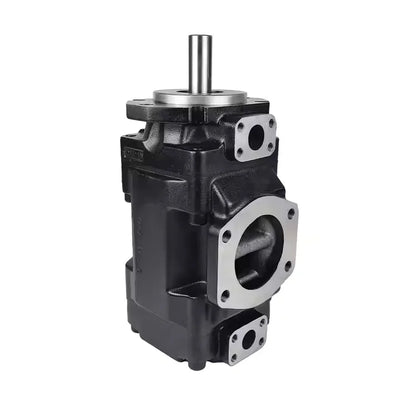
Many machines need more than one flow. A double vane pump puts two cartridges on one shaft, often a large one for fast moves and a small one for holding high pressure. Triple units add a third circuit. The Parker Denison T6 family is a well-known example, used on presses and mobile machines worldwide.
When you replace a double or triple pump, note the displacement of each section, front to back, and which outlet feeds which circuit.
The Cartridge Advantage
On many vane pumps, the rotor, vanes, cam ring and side plates come as one cartridge kit. That brings three real benefits:
- Repairs are quick. The housing stays on the machine, and the cartridge slides out.
- Flow can change. On some models, fitting a larger or smaller cartridge in the same body adjusts the output.
- Spares are compact. Keeping a cartridge on the shelf costs less than keeping a full pump.
If the housing, shaft or seals are damaged, a complete pump is usually the better buy. We will help you compare both options.
Vane Pump Specifications to Check
Confirm these details before ordering:
- Displacement: from a few cc/rev to over 200 cc/rev on large double pumps.
- Pressure: fixed balanced designs often reach 210 to 280 bar, while variable vane pumps usually run lower, at around 70 to 160 bar.
- Minimum speed: the vanes need enough speed to throw them out against the ring, often around 600 rpm. Below that, the pump may not prime.
- Rotation: on some models you can change it by turning the cartridge around, but check the maker's guidance first.
- Mounting and shaft: SAE or ISO flange, with a keyed or splined shaft.
- Ports: size, type and position. Ports can often be clocked to suit your pipework.
Common Vane Pump Problems
Most vane pump faults come back to oil condition or start-up:
- No flow at start-up: speed too low, wrong rotation, or air in the suction line.
- Noisy running: cavitation, aeration, or chatter marks worn into the cam ring.
- Falling flow: varnish or dirt makes the vanes sticky, so they no longer reach the ring.
- Overheating: a variable pump with its compensator set too high, or a worn cartridge leaking internally.
Vane designs dislike dirty oil more than gear pumps do. Fit quality filters, change them on schedule, and keep the oil cool.
Fitting a New Vane Pump
A few minutes of care at start-up protects a new pump:
- Check the rotation arrow against the drive before you bolt it on.
- Fill the pump body with clean oil through the outlet.
- Loosen an outlet fitting and jog the motor until oil appears, then tighten it.
- Start with the circuit unloaded, so the pump primes against low pressure.
- Listen for a steady hum. A rattle or whine means air is still in the system.
On variable pumps, set the compensator last, once the oil is warm and the air is out.
Where Vane Pumps Work
Vane pumps are at home on machine tools, injection moulding machines, presses and indoor power units where low noise matters. You also find them on refuse trucks, buses and mobile plant for steering and auxiliary circuits, where their smooth flow gives a light, steady feel at the controls. In mobile work, many double vane pumps also feed the brakes or cooling fan from their second section.
Vane, Gear or Piston?
Each family has a sweet spot. Choose vane pumps for quiet, medium-pressure work and easy repair. Choose gear pumps for simple, low-cost duties and dirty conditions. Choose piston pumps when you need high pressure and the best efficiency.
On energy-hungry machines, a servo hydraulic setup can cut running costs further. For unusual duties, our specialty hydraulic pumps cover the jobs standard ranges miss. If you are unsure which way to go, our pump selection and sizing service will help you decide.
Why Buy Vane Pumps From TSA Hydraulics Engineering
As a vane pumps supplier, we look past the frame size to the cartridge, the section sizes and the minimum speed your drive can deliver. You get honest advice on whether to buy a cartridge or a complete pump, and help sourcing vane pumps replacement parts such as cartridge kits and seal kits. We always tell you upfront whether a part is genuine or an equivalent.