

// Catalogue
Temperature Sensors
1product


Similar products
// Buying guide
Types of Temperature Sensor
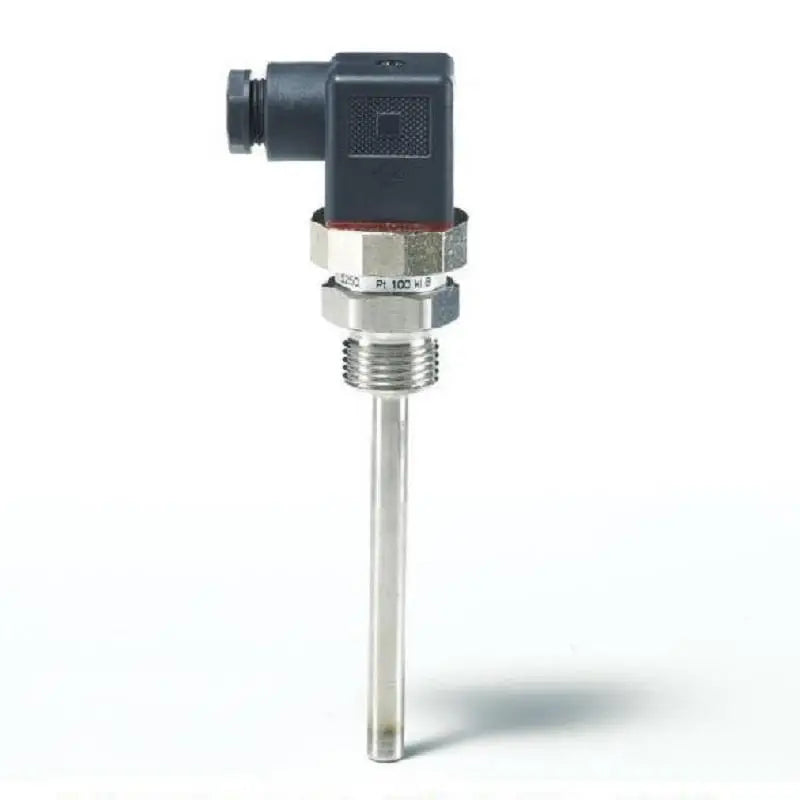
- RTD probes (Pt100 and Pt1000): accurate and stable, and the standard in industrial hydraulics.
- Thermistors (NTC): low cost and fast, common on mobile machines and coolers.
- Thermocouples: for very high temperatures, and less common in hydraulic oil.
- Temperature transmitters: turn a probe signal into 4 to 20 mA or 0 to 10 V for the PLC.
- Temperature switches: mechanical or electronic, flipping a contact at a set point.
- Level and temperature switches: one unit on the tank that watches both.
Where to Measure
- Tank return: shows the overall heat in the system.
- Pump inlet: confirms the oil is warm enough to pump, and not too hot.
- Case drain: a rising case drain temperature often points to a pump wearing inside.
- Cooler inlet and outlet: the difference shows whether the cooler is doing its job.
- Motors and bearings: winding and bearing sensors protect the drive.
Setting Switch Points
- Fan control: switch the cooling fans on as the oil warms and off as it cools, with a gap between the two so the fan doesn’t cycle.
- Warning alarm: set below the oil and seal makers’ limits, so there is time to act.
- Shutdown: a higher trip point that stops the machine before damage.
- Heater control: warm the oil on cold mornings before full pressure is used.
Probes, Thermowells and Fittings
- Pick a probe length that reaches flowing oil, not a dead pocket.
- A thermowell lets you change the sensor without draining the system, though response is a little slower.
- Match the thread, such as G1/2 or 1/2 NPT, and the sealing style.
- Check the electrical connector, such as M12 or DIN, and the cable length.
Making Use of Temperature Data
- Trend the case drain temperature to spot pump wear months ahead.
- Compare the cooler inlet and outlet to see when it needs cleaning.
- Combine temperature with flow to work out the real heat load.
- Log readings alongside pressure to find the hottest part of the cycle.
Signs of a Faulty Sensor
- Readings that jump or drop out, often a cable or connector problem.
- A reading that doesn’t change when the oil clearly warms up.
- Fans that never start, or never stop.
- Two sensors on the same line that disagree by more than a few degrees.
Temperature Sensors Specifications to Check
- Sensor type and measuring range
- Output signal or switch points
- Probe length, diameter and thread
- Accuracy and response time
- Electrical connector and protection rating
- Maximum pressure at the probe
Why Buy From TSA Hydraulics Engineering
As a temperature sensors supplier, we match the sensor type, probe length, thread and output, so the new part fits and reads like the old one. You get OEM or equivalent options, and help sourcing temperature sensors replacement parts such as thermowells, connectors, cables and transmitters. We tell you upfront whether a sensor is genuine or an equivalent.