

// Catalogue
25products


Filters
Sort Best selling







Similar products

// Buying guide
How a Vertical Inline Pump Differs
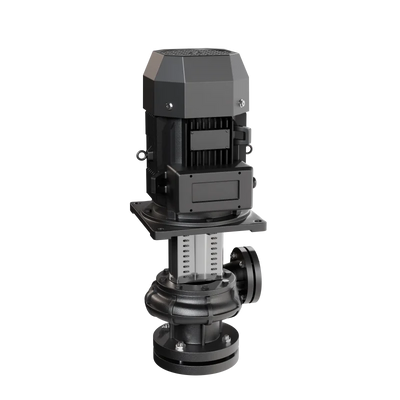
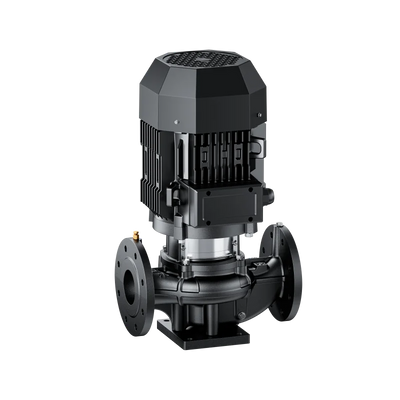
Most vertical inline pumps are single-stage centrifugal pumps turned on their side. Liquid enters on one side, passes through the impeller and leaves on the opposite side, along the same center line. The motor sits above, driving the impeller through a short shaft.
That layout brings real advantages:
- Small footprint: the pump takes up little more floor space than the pipe itself.
- Simple piping: no elbows are needed to turn the flow into and out of the pump.
- Quick install: no baseplate, grouting or long coupling alignment.
- Easy access: on most models, the motor and internals lift out from the top.
Types of Vertical Inline Pumps
Close Coupled Inline Pumps
The impeller fits straight onto the motor shaft. These pumps are compact and affordable, and they suit most small and medium building services duties.
Split Coupled Inline Pumps
A short spacer coupling sits between the motor and the pump shaft. When the seal needs changing, you remove the coupling and slide the seal out without lifting the motor. On larger pumps, that can turn a half-day job into an hour.
Twin Head Inline Pumps
Two pump heads share one casing, with a flap valve that stops flow passing back through the idle head. One runs while the other stands by, or both run together at peak demand. You get a built-in duty and standby setup in the space of one pump. Most controllers swap the heads on a timer to even out wear, and switch over automatically if the running head faults.
Built for Building Services
Vertical inline pumps are a favourite in commercial buildings, hospitals, schools and data centres. Typical duties include:
- Chilled water circulation for air conditioning.
- Heating hot water loops.
- Condenser water for cooling towers.
- Domestic hot water recirculation.
- Pressure boosting for upper floors.
Many modern inline pumps come with an integrated variable speed drive. The drive senses demand and slows the pump when less flow is needed. That saves a large share of the energy on systems that rarely run at full load.
Control Modes Worth Knowing
Pumps with integrated drives often offer several ways to run:
- Constant pressure: holds the same pressure as demand changes, which is ideal for boosting.
- Proportional pressure: lowers pressure as flow drops, which suits heating and cooling loops with control valves.
- Constant speed: runs like a standard pump, which is useful during commissioning.
- Sensorless control: the drive estimates flow and head from motor data, so no separate sensor is needed.
Choosing the right mode can add savings on top of the drive itself, at no extra cost.
Installation Tips
Inline pumps rely on the pipework around them, so a few points matter:
- Support the pipes on both sides of the pump, so the casing carries no pipe weight.
- Fit the pump on a stand or pedestal where the size calls for it.
- Leave enough height above the motor to lift it out for service.
- Fit isolation valves on both sides, so the pump can come out without draining the system.
- Allow a short straight run of pipe before the inlet.
Pipe strain is the number one cause of seal and bearing trouble on inline pumps. Getting the supports right at install saves money for years. On larger pumps, a small drain line from the seal area to a floor drain also keeps the plant room dry.
Vertical Inline Pumps Specifications to Check
- Flow and head at your duty point.
- Pipe and flange size, inlet and outlet.
- Motor power, speed and voltage, plus any integrated drive.
- Single head, twin head or split coupled design.
- Fluid type and temperature, including any glycol mix.
- Seal type and casing material.
- Maximum working pressure of the system.
Glycol mixes are thicker than water and change the duty, so always tell us the mix percentage and the lowest operating temperature.
Signs Your Inline Pump Needs Attention
- Water around the base, which usually means a seal leak.
- A humming or grinding motor, which points to worn bearings.
- Rooms that are too warm or too cold, a sign the pump is losing flow.
- Rising power use at the same duty.
- A twin head pump where one head no longer starts, leaving no standby.
What to Send Us
A photo of the nameplate is the best start, as it usually shows the model, flow, head and motor size. Add the pipe size and the building or plant system the pump serves. If the pump has an integrated drive, include the drive label too, as settings and features vary between makers.
Inline or Another Layout?
If floor space is not a concern and you want the lowest cost, end suction pumps on a baseplate are often cheaper. For high head in a vertical package, vertical multistage pumps stack several impellers in the same inline style. For very large flows, split case pumps are usually the better choice. Not sure which fits your system? Our pump selection and sizing service will help.
Where Vertical Inline Pumps Work
Popular families include the Grundfos TP range, used in buildings around the world. Beyond building services, inline pumps also handle cooling loops in factories, process water circulation and light industrial transfer where space is tight. In data centres, twin head pumps are common because cooling cannot stop, even for a seal change.
Why Buy From TSA Hydraulics Engineering
As a vertical inline pump supplier, we match pipe sizes, flange ratings, and drive options, not just flow and head. You get clear prices in AUD, OEM or equivalent options, and help sourcing vertical inline pump replacement parts such as mechanical seals, impellers, and couplings. We tell you upfront whether a pump is genuine or an equivalent.