
// Catalogue
14products


Filters
Sort Best selling







Similar products

// Buying guide
How a Liquid Ring Vacuum Pump Works
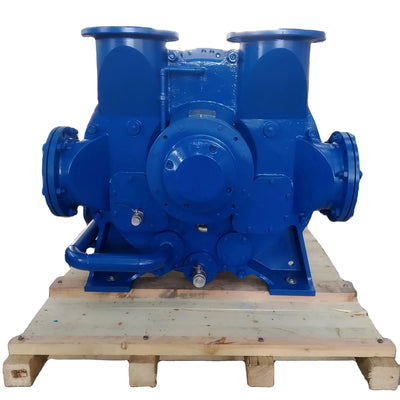
This vacuum pump has a bladed impeller set off centre in a round casing that is part filled with water. As the impeller spins:
- The water is thrown outward and forms a ring that follows the casing.
- Because the impeller is off centre, the pockets between the blades grow on one side and shrink on the other.
- The growing pockets draw gas in through the inlet port.
- The shrinking pockets compress the gas and push it out with some of the water.
The water also cools the gas as it is compressed, so the pump runs cool even on hot, wet duties.
Why Seal Water Temperature Matters
The seal water limits how deep a vacuum a liquid ring pump can reach. Warm water boils more easily under vacuum, and that vapour fills the pockets instead of your process gas.
- Most pumps are rated with water at about 15°C.
- Warmer water lowers both the deepest vacuum and the pumping speed.
- Too little seal water flow lets the ring overheat.
- Too much flow wastes power and water.
If performance drops in summer, check the seal water before you blame the pump.
Seal Water Arrangements
- Once through: fresh water in, waste water out. It is simple, but it uses a lot of water.
- Partial recirculation: some of the water is reused, which cuts consumption.
- Full recirculation: a closed loop with a separator and heat exchanger. It uses very little water and suits sites where the seal liquid must not reach the drain.
Single or Two Stage?
Single stage pumps suit most duties down to about 150 mbar and handle large gas volumes. Two stage pumps run two impellers in series and work better at deeper vacuum, often down to around 30 to 50 mbar with cool seal water.
Watch for Cavitation
A rattling, gravelly noise at deep vacuum is usually cavitation, and it erodes the impeller and port plate. Keep the pump within its rated range and cool the seal water. If the maker offers an anti cavitation line, fit one.
Liquid Ring Vacuum Pumps Specifications to Check
- Required vacuum level and pumping speed
- Gas type, vapour load and any liquid carryover
- Seal water temperature and arrangement
- Single or two stage design
- Casing and impeller materials, such as cast iron or stainless steel
- Motor power, voltage and speed
Where They Work
Paper machines, power station condensers, chemical reactors, vacuum filters in mineral processing, sugar refining and plastics extrusion all lean on liquid ring pumps. For clean, dry gas, a rotary vane pump is often cheaper. Where seal water must never touch the process, a dry screw vacuum pump may suit better. Our packaged vacuum systems combine pumps, separators and controls on one skid.
Why Buy From TSA Hydraulics Engineering
As a liquid ring vacuum pumps supplier, we check seal water, stage count and materials, not just the vacuum figure. You get clear prices in AUD, OEM or equivalent options, and help sourcing liquid ring vacuum pumps replacement parts such as impellers, port plates, mechanical seals and bearings. We tell you upfront whether a pump or part is genuine or an equivalent.