
// Catalogue
35products


Filters
Sort Best selling






Similar products

// Buying guide
How a Multistage Pump Builds Pressure
Each stage is a small centrifugal pump: an impeller plus a diffuser that turns speed into pressure. The liquid leaves the first stage and goes straight into the eye of the next, picking up more pressure each time.
The key idea is simple:
- Head adds up: four stages give roughly four times the head of one stage.
- Flow stays the same: the same liquid passes through every stage in turn.
So when you need more pressure but not more flow, you add stages instead of buying a bigger pump. Small impellers spinning fast also keep the pump slim and efficient.
Vertical or Horizontal?
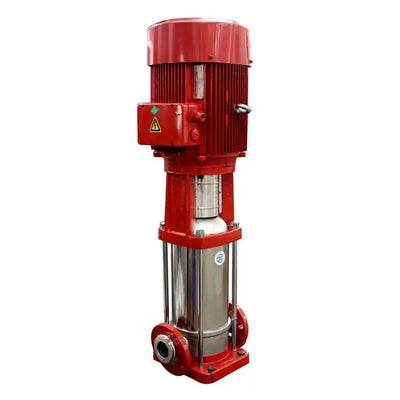
Vertical Multistage Pumps
The stages stack up a central shaft, with the motor on top. The inlet and outlet usually sit on the same line at the base, so the pump drops into a pipe run and takes up very little floor space. Most of these pumps are made from stainless steel, which suits clean water, washdown and many light chemicals. On designs with a cartridge seal under the motor, changing the seal is quick.
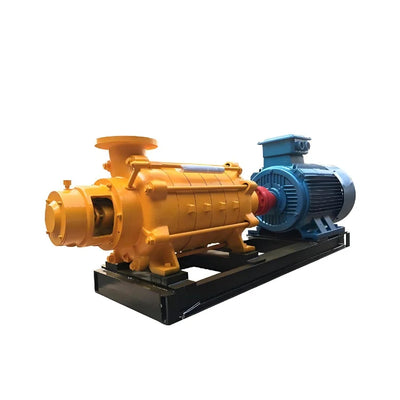
Horizontal Multistage Pumps
The stages line up along a horizontal shaft, driven by a motor on a baseplate. This layout handles bigger flows, higher pressures and hotter liquids, so it is common for boiler feed, mine dewatering and large water supply duties. Ring section designs bolt the stages together with long tie rods, which means you can change the number of stages during a rebuild.
Reading the Model Code
Ordering by model code avoids most sizing mistakes. On many vertical multistage pumps:
- The letters show the series and material, for example cast iron or stainless steel.
- The first number shows the nominal flow in cubic metres per hour.
- The second number shows the number of stages.
- Extra letters cover the seal, connections and motor options.
Two pumps with the same flow figure but different stage counts deliver very different pressures. Always check the full code, not just the first number.
Where Multistage Pumps Shine
- Pressure boosting in high-rise buildings
- Boiler feed water in power and process plants
- Reverse osmosis and water treatment membranes
- Washdown and cleaning systems in food plants
- Mine dewatering from deep pits
- Irrigation and spray systems that need high pressure
- Snow making and high-pressure misting
Booster Sets and Speed Control
Many buildings run two or three multistage pumps on one skid, with a controller that starts and stops them as demand changes. Add a variable speed drive and the set holds a steady pressure while using only the power it needs. Our variable speed drive pumps range covers pump and drive packages built for this.
Where a stoppage is not an option, a duty and standby layout keeps the water flowing. See our redundant pump systems (duty/standby) page for how that works.
Running Rules That Save Seals and Bearings
Multistage pumps are tough, and a few habits keep them that way:
- Vent before you start. Open the vent plug at the top until liquid flows, so no air sits around the seal.
- Never run dry. Even a few seconds can ruin the mechanical seal.
- Keep a minimum flow. Running against a closed valve heats the liquid fast. Fit a bypass if demand can drop to zero.
- Watch the inlet pressure. Hot boiler feed water needs plenty of NPSH, or the first stage will cavitate.
- Stay within the inlet pressure limit. On boosting duties, inlet pressure plus pump pressure must stay within the casing rating.
Multistage Pumps Specifications to Check
- Flow and head at your duty point
- The full model code, including the stage count
- Inlet and outlet sizes, and whether they are flange or union connections
- Maximum inlet pressure and casing pressure rating
- Fluid type and temperature
- Pump and seal materials
- Motor power, speed, voltage and any built-in drive
Signs Your Pump Needs Attention
- Lower pressure at the same flow, often from worn stages or wear rings
- Drips or a white crust around the seal
- A rattle at start up, which can point to air in the pump or cavitation
- Rising power use or motor temperature
- A booster set that cycles on and off far more often than before
Short cycling often traces back to a failed pressure tank or a faulty sensor, not the pump itself, so check the controls first.
Multistage or Another Pump?
For large flows at moderate pressure, split case pumps are usually more efficient. If the pressure you need is modest and cost matters most, end suction pumps are simpler and cheaper. If the pump has to sit well above the water level, a self-priming design may suit better. Our energy efficiency and servo retrofits team can also check whether an existing pump set is wasting power.
What to Send Us
A photo of the nameplate is the best start, because it shows the full model code, stage count and motor. Tell us the liquid, its temperature and the pressure at the pump inlet. For booster sets, let us know how many pumps run and how the controller is set up.
Why Buy From TSA Hydraulics Engineering
As a multistage pumps supplier, we match the full model code, stage count and connections, not just a flow figure. You get clear prices in AUD, OEM or equivalent options, and help sourcing multistage pumps replacement parts such as mechanical seals, stage kits, wear rings and bearings. Popular families such as the Grundfos CR range are a common starting point. We tell you upfront whether a pump is genuine or an equivalent.