

Filters
Sort Best selling






Similar products

// Buying guide
Centrifugal or Positive Displacement?
Every process pump falls into one of two families. The right one depends mostly on the fluid and how steady the flow must be.
- Centrifugal pumps spin an impeller to throw liquid outward. They move large volumes of thin fluid smoothly, but their flow changes as system pressure changes.
- Positive displacement pumps trap a fixed amount of liquid and push it out. Their flow stays steady against changing pressure, and they handle thick, abrasive or delicate fluids well.
Rule of thumb: water and thin chemicals usually suit centrifugal pumps. Anything thicker than light oil, or anything that must be dosed accurately, usually suits positive displacement.
Centrifugal Pump Types
Centrifugal Pumps
Centrifugal pumps are the workhorses of water supply, cooling, washdown and general transfer. They are simple, efficient at their design point, and easy to maintain. This range covers general-purpose models for most clean or lightly dirty liquids.
End Suction Pumps
End suction pumps draw liquid in through the front and push it out the top. Their compact, single-stage design makes them the most common choice for water transfer, irrigation, HVAC circulation, and light industrial duties.
Vertical Inline Pumps
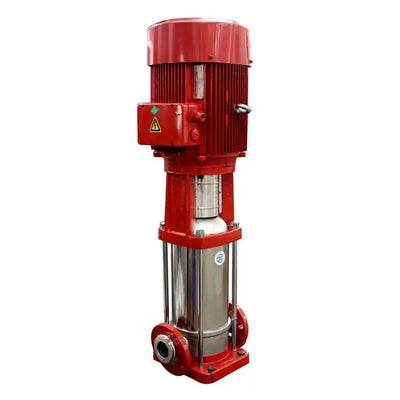
Vertical inline pumps have the inlet and outlet in a straight line, so they drop straight into a pipe run. They save floor space in plant rooms and suit building services, chilled water loops and boosting duties.
Split Case Pumps
Split case pumps open along the middle, so you can reach the impeller and bearings without moving the pipework. They handle big flows for water mains, fire services, cooling towers and large industrial plants.
Self-Priming Pumps
Self-priming pumps can clear air from the suction line and lift liquid from below the pump. They suit sumps, tanks, wash bays and dewatering, where the pump sits above the liquid.
Multistage Pumps
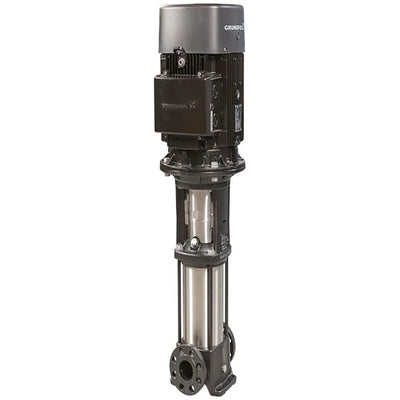
Multistage pumps stack several impellers in one casing to build high pressure. They are the go-to choice for boiler feed, reverse osmosis, high-rise boosting and washdown systems. Popular designs include the Grundfos CR range of vertical multistage pumps.
Positive Displacement Process Pumps
Diaphragm Pumps
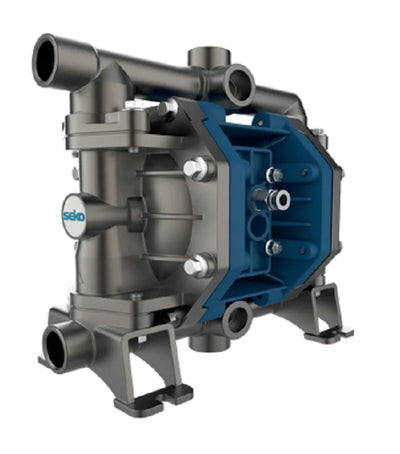
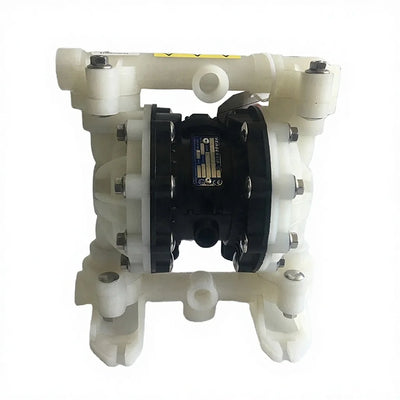
Diaphragm pumps use a flexing diaphragm to move liquid, with no seals that can leak. Air-operated versions can run dry without damage, which suits chemicals, paints, slurries and drum transfer.
Peristaltic Pumps
Peristaltic pumps squeeze a flexible hose to push liquid along. Only the hose touches the fluid, so they are ideal for dosing, abrasive slurries, and shear-sensitive or sterile liquids.
Progressive Cavity Pumps
Progressive cavity pumps use a rotor turning inside a rubber stator to move liquid in sealed pockets. They give smooth, steady flow and handle thick sludge, pastes and fluids with solids.
Screw Pumps
Screw pumps use two or three meshing screws to move fluid with very low pulsation. They suit fuel oil, lubrication oil and other viscous liquids, especially where long, quiet running matters.
Lobe Pumps
Lobe pumps use two rotating lobes that never touch each other. They treat delicate products gently and clean easily, which makes them popular in food, beverage, dairy and cosmetics plants.
Match the Pump to the Fluid
Use this quick guide as a starting point:
- Clean water and thin liquids: end suction, vertical inline, split case or multistage pumps.
- Water with air or a suction lift: self-priming pumps.
- Thick oils and fuels: screw or lobe pumps.
- Sludge, pastes and solids: progressive cavity pumps.
- Abrasive slurries: peristaltic or diaphragm pumps.
- Food and hygienic products: lobe or peristaltic pumps.
- Accurate chemical dosing: diaphragm or peristaltic pumps.
How We Size a Process Pump
Many pump failures and energy losses happen because a pump was chosen on flow and pressure alone. We look at the whole system:
- Duty point: the flow you need and the total head the pump must overcome.
- System curve: static head plus friction losses in pipes, valves and fittings.
- Suction conditions: the NPSH available against the pump's NPSH required, so it does not cavitate.
- Fluid properties: density, viscosity, temperature, solids and vapour pressure.
- Best efficiency point: running the pump close to its BEP for long life and low power use.
You receive a short report with the recommended pump, the operating point, the NPSH margin and the motor size. Our pump selection and sizing service handles single pumps, while system design and modelling covers new or changed pipework.
Materials and Seals
The wetted parts must suit the fluid:
- Cast iron: water and neutral liquids.
- Stainless steel: food, drinking water and many chemicals.
- Duplex or special alloys: seawater and aggressive chemicals.
- Plastics: acids and corrosive solutions.
Seal choice matters just as much. Mechanical seals suit most duties, gland packing suits some slurries, and sealless designs such as diaphragm and peristaltic pumps remove the leak path altogether.
Packaged Pump Skids
When a project needs more than a single pump, we can supply complete packages built with our fabrication partners: pumps, valves, instruments and controls mounted on one base frame. Process pump skids arrive ready to connect, which cuts site work and installation errors.
Industries We Serve
Our process and transfer pumps work in water and wastewater plants, food and beverage production, chemical processing, mining and minerals sites, building services and agriculture. Each industry brings its own fluids, materials and standards, and we match the pump to all three.
Process & Transfer or Something Else?
If your job is driving cylinders and hydraulic motors rather than moving process liquid, you need our hydraulic pumps instead. If you need to remove air or gas, our vacuum and specialty pumps are the right place to look.
Why Buy From TSA Hydraulics Engineering
As a process and transfer pumps supplier, we start with your fluid and your system, not a catalogue page. You get genuine or equivalent options from leading makers, and help sourcing process and transfer pumps replacement parts like impellers, mechanical seals, stators and diaphragms. We tell you upfront whether a pump is genuine or an equivalent.