

// Catalogue
65products


Filters
Sort Best selling







Similar products

// Buying guide
How a Centrifugal Pump Works
Liquid enters at the centre, or eye, of a spinning impeller. The vanes throw it outward at speed. The casing, called a volute, then slows the liquid down and turns that speed into pressure. The result is smooth, continuous flow with very few moving parts.
Unlike positive displacement pumps, a centrifugal pump does not push a fixed volume. Its flow rises or falls with the resistance of the system it feeds, which is why the system matters as much as the pump.
Reading a Pump Curve
Every centrifugal pump has a curve that shows how flow and head trade off. Four points matter most:
- Shut-off head: the highest head the pump can make, at zero flow.
- Best efficiency point (BEP): where the pump runs most efficiently and lasts longest.
- Run out: the far right of the curve, where flow is high but efficiency drops and the risk of cavitation rises.
- NPSH required: the suction pressure the pump needs to avoid cavitation, which rises with flow.
The pump will actually run where its curve crosses your system curve. Aim to land within about 80 to 110% of BEP flow. If you are unsure where your pump will land, our pump selection and sizing service can plot it for you.
Impeller Types
- Closed impellers: shrouded on both sides, for the best efficiency on clean liquids.
- Semi open impellers: one shroud, handling some solids and fibres.
- Open impellers: no shrouds, used for slurries and stringy material.
- Vortex impellers: set back in the casing, so solids pass through with little clogging.
The right impeller depends as much on what is in the liquid as on how much of it you need to move.
The Affinity Laws: Why Speed Control Saves So Much
Change the speed of a centrifugal pump and three things happen:
- Flow changes in line with speed.
- Head changes with the square of speed.
- Power changes with the cube of speed.
Cut the speed by just 20% and power use drops by almost half. That is why fitting a variable speed drive to a pump that spends hours throttled back can pay for itself quickly. Our variable speed drive pumps range covers drive and pump packages built for this.
Common Centrifugal Pump Problems
Most problems trace back to running the pump away from its design point:
- Cavitation: a gravelly noise and a pitted impeller, caused by low suction pressure. Check the NPSH available.
- Running far left of BEP: heat, vibration and seal failures from recirculating flow.
- Running far right of BEP: high power draw, plus cavitation at high flow.
- Dry running: destroys mechanical seals in seconds. Prime the pump and fit protection.
- Dead heading: running against a closed valve heats the liquid fast and can damage the pump.
If a pump keeps failing, the cause is often in the system. Our system design and modelling service can map the system curve and find it.
Is Your Pump Oversized?
Oversizing is one of the most common and expensive mistakes in pumping. Look for these signs:
- A discharge valve that is always partly closed.
- A pump that runs well left of its BEP.
- Higher power bills than the duty seems to need.
- Frequent seal and bearing failures.
The fix may be a smaller pump, a trimmed impeller or a variable speed drive. Our energy efficiency and servo retrofits team can measure the current duty and estimate the savings and payback.
Installing for a Long, Quiet Life
Many centrifugal pump problems start at installation. A few simple rules help:
- Give the suction a straight run of pipe, ideally five to ten pipe diameters, before the pump inlet.
- Use an eccentric reducer on the suction, flat side up, so air cannot collect.
- Keep elbows and valves away from the inlet, where they upset the flow.
- Support the pipework so it does not strain the pump casing.
- Check shaft alignment after the pipework is connected, not before.
These steps protect the seals and bearings and keep the pump close to its rated performance.
Centrifugal Pump Specifications to Check
Before you order, confirm:
- Flow rate and total head at your duty point.
- NPSH available at the suction side.
- Fluid type, temperature, density, and viscosity.
- Solids content and particle size.
- Casing and impeller materials.
- Seal type: mechanical seal, packing or a magnetic drive.
- Motor power, speed, and supply voltage.
- Flange sizes and pipe connections.
Choosing a Centrifugal Layout
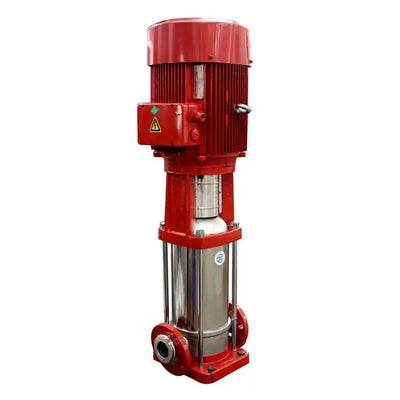
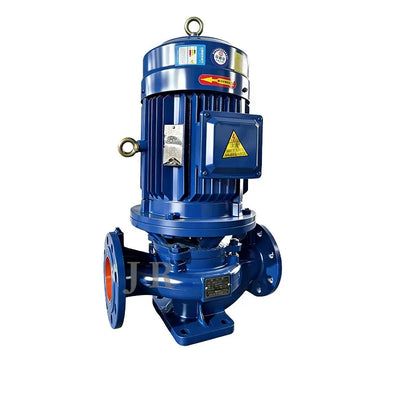
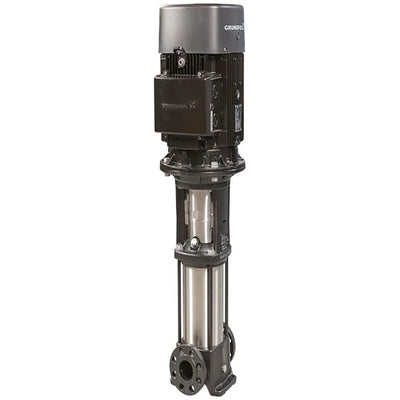
The basic centrifugal design comes in several layouts, each with its own strengths. End suction pumps are compact and the most common choice for general duties. Vertical inline pumps drop straight into pipework and save floor space. Split case pumps handle very large flows and are easy to service. For high pressure, multistage pumps stack several impellers in one casing. If the pump must lift liquid from below, self-priming pumps clear the air on their own.
Where Centrifugal Pumps Work
- Water supply, boosting and irrigation.
- Cooling water and chilled water loops in HVAC systems.
- Process transfer in food, chemical and mining plants.
- Washdown, fire services and general plant utilities.
Leading makers such as Grundfos build centrifugal pumps for most of these duties.
What to Send Us
For a replacement, send the nameplate details and a photo of the pump. For a new duty, tell us the flow, the head or pressure, the fluid and its temperature, and how the suction is arranged. A rough sketch of the pipework is often more useful than you might think.
Why Buy From TSA Hydraulics Engineering
As a centrifugal pump supplier, we size pumps from your system, not just a flow figure on an order form. You get OEM or equivalent options, and help sourcing centrifugal pumps replacement parts such as impellers, wear rings and mechanical seals. We tell you upfront whether a pump is genuine or an equivalent.